Tag: audio description

  • Launching Caption This Cinema

    Launching Caption This Cinema

    Caption This Cinema is a brand new film exhibitor with access at its core, championing diverse stories and disabled audiences, and will be launching its virtual inaugural screening of Vision Portraits from 17th – 19th November.
    Logo for Caption This Cinema. At the bottom, a red outline of three cinema seats. Behind them, a black background with a white line depicting the outline of  a cinema screen. In the middle of the screen, the words "caption this, accessible cinema" in bold, white letters.

    Vision Portraits (2019) is a deeply personal film by Rodney Evans, a filmmaker who explores what it means to have vision while confronting his own sight loss. He connects with three visually impaired artists, a dancer, a writer, and a photographer, and turns to them for guidance and insight. 

    Vision Portraits will be available to watch through the screening platform Eventive from Wednesday 17th to Friday 19th November. The film will have English captions available as well as English audio description. Tickets will be on a pay-what-you-can sliding scale from £0, £2, £4, £6, £8.  There will be a live discussion over Zoom and live-streamed to Eventive on Friday 19th November at 7pm with guest speakers Theresa Heath and Tara Brown. The live discussion will have live captioning, BSL interpretation, and the host and guest speakers will provide visual descriptions of themselves to make the event more accessible for partially sighted audiences. 

    Caption This Cinema is a pop-up cinema that strives to empower and prioritise Deaf and Disabled communities by reflecting this value in its programming and access measures, providing hybrid virtual and in-person screenings throughout the year and across Scotland.  Caption This Cinema was developed by Charlotte Little, a young deafblind access consultant and programmer, who has combined her passion for curation, her experiences as a disabled moviegoer, and her expertise in disability and access within the film industry, to create CTC.

    You can purchase tickets for Vision Portraits through Eventive.

    Follow Caption This on Twitter: @captionthiscine

    Funding and Support:

    CINEMA FOR ALL has supported the development of Caption This Cinema and the inaugural screening of Vision Portraits through their Access Launchpad scheme. 

    FILM HUB SCOTLAND is supporting this inaugural screening through their Pitch Pot fund.

    MATCHBOX CINE has provided ongoing guidance, technical support, and captioning support for Caption This Cinema.

  • Describing Audio Description

    Describing Audio Description

    Audio Description (AD) is a narration track that is played in addition to the dialogue and soundtrack of a film; it is primarily intended to benefit blind and visually impaired audiences. The commentary describes the visual elements of the media, such as body language and expressions which can assist a blind or visually impaired person’s enjoyment of a film, especially if these visual elements are crucial to the film’s storytelling. The first audio-described programme to air on UK television is believed to have been Coronation Street, over 25 years ago. 2018 saw the first audio-described advert which was championed by Fairy Liquid and broadcasted on ITV.

    Curious to hear how audio description sounds? Here’s an audio described trailer for Frozen

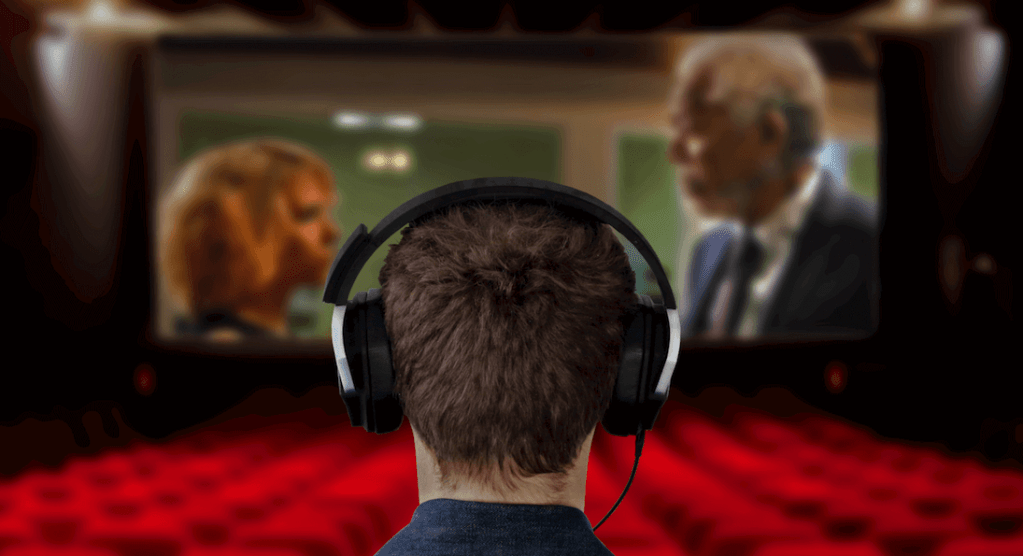
    Many cinemas have AD facilities installed, a system that delivers AD through a headset. Headsets are generally provided at the box office when customers collect their tickets; the AD track is undetectable unless you are wearing a headset yourself. Streaming services such as Netflix and Amazon Prime usually provide AD for their content, as well as online broadcaster services such as BBC and Channel 4.

    Several theatres across the UK provide audio description, this is delivered through means of infrared, radio or WiFi to a receiver that customers can book in advance. Audiences can familiarise themselves with the set in advance of the audio described performance by attending an onstage touch tour where they have the opportunity to handle props and customers, and to meet the cast.

    Museums and galleries offer audio description through a variety of options to support accessibility for blind people. Recorded AD guides can help blind or visually impaired people enjoy visiting galleries independently. These guides supply descriptions of the exhibitions as well as directions to aid navigation through the establishment. Some museums and galleries offer opportunities to touch particular artefacts as part of a group. Many museums and galleries have created tactile replicas of famous artworks, such as the Van Gogh Museum in Amsterdam with their ‘Feeling Van Gogh‘ programme. This programme is an interactive exhibition where people can feel, smell and listen to the ‘Sunflowers’.

    Van Gogh's painting of sunflowers in a vase with a yellow background
    Vincent van Gogh’s ‘Sunflowers’

    Advocates are aiming to ensure all platforms are streaming accessible content, and the next push is for adverts to adopt audio description tracks. Apple has announced that the Apple TV+ will be optimised to be accessible for both blind and deaf audiences.

    “Audiences worldwide can enjoy Apple TV+ originals subtitled and/or dubbed in nearly 40 languages, including Subtitles for the Deaf and Hard-of-Hearing (SDH) or closed captions. Apple TV+ series and movies will also be available with audio descriptions in eight languages.”

    Apple

    If you wish to learn more about audio description, then visit the Royal National Institute for the Blind (RNIB) website.